
01
Configure the AI
Point it at the machine. The autoencoder learns that asset's own normal — no expert spectra setup.

Runs on industrial PCs
On Beckhoff hardware you own. No Subscription. No Cloud Lock-In. From threshold alarms to edge AI, on Data with real meaning.
hardware availability
data ownership
acquisition cost
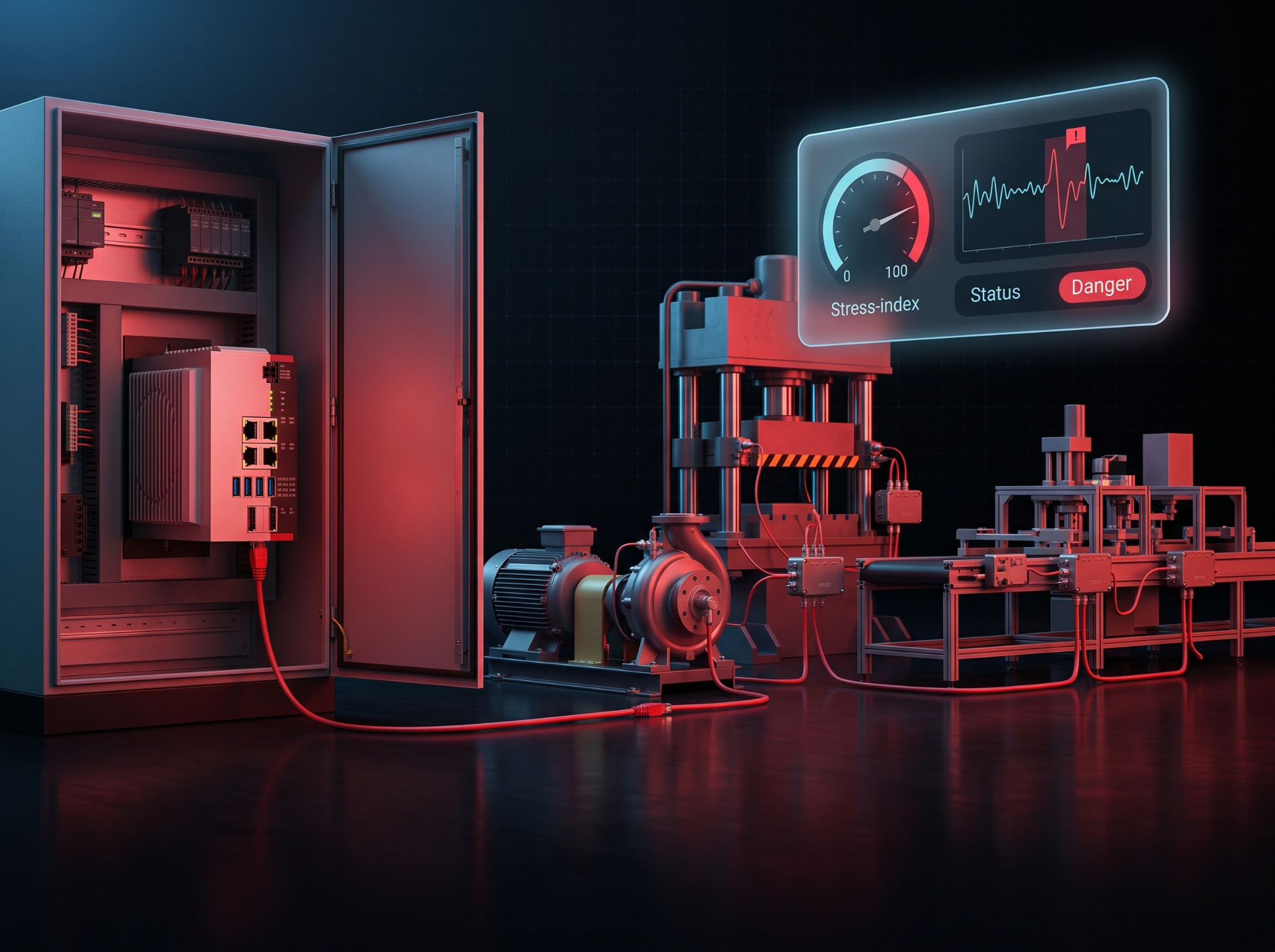
Wired · EtherCAT
Know a bearing is failing three weeks before it does
Autonomous edge AI scores a 0–100 Machine Stress Index from 24-bit, 50 kS/s raw capture — alarms and physical I/O react in sub-seconds, no cloud round-trip.
Northbound on open protocols


For plant managers
Sold, versus needed.
Legacy systems
SensorDataFabrics
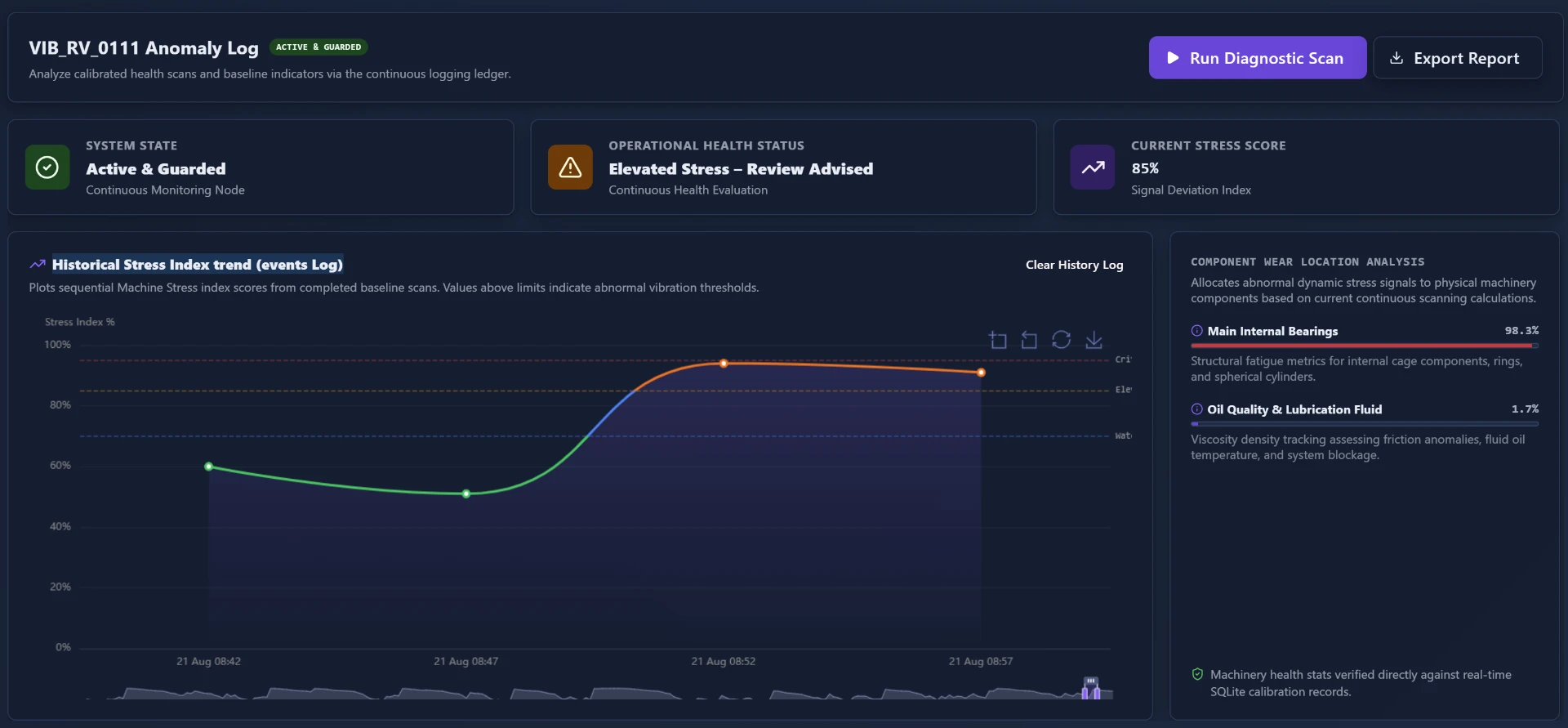
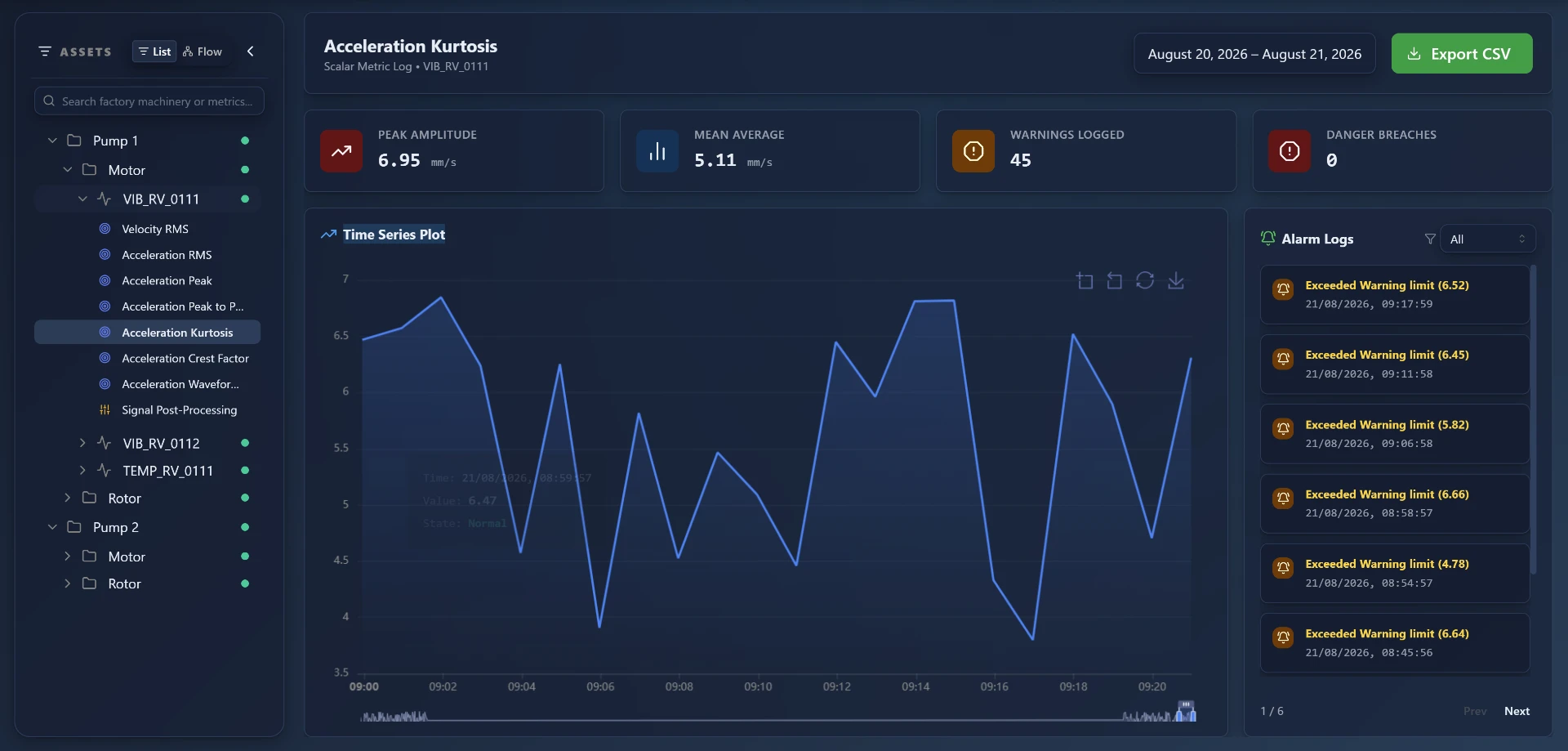
Long-horizon logging on the node — compression-first storage keeps months of history, so the evidence is still there when the AI points at it.
Point it at the machine. The autoencoder learns that asset's own normal — no expert spectra setup.
Machine Stress Index climbs out of band. Watch → Warning → Danger, locally, in under a second.
Open the captures around the event and run the post-processing that answers why.
Post-processing toolkit — on demand, on the recorded data
FFT spectrum
harmonics, BPFO / BPFI lines
STFT waterfall
how the spectrum evolved
Power spectral density
broadband energy
Demodulation
envelope, early bearing defects
Cepstrum
sideband families, gear mesh
Spectral kurtosis
where the impulsiveness lives
Time domain
the raw waveform itself
 Official ecosystem hardware
Every SensorDataFabrics node runs on a standard Beckhoff industrial PC — CX9240 to C6030 — with TwinCAT and EtherCAT underneath. If we disappeared tomorrow, your hardware, spares and support contracts would still come from a global automation vendor you can already buy from.
Open by design
Built on standards you already run.





Pick wired or wireless per site — how many sensors you can run comes down to the Beckhoff IPC you put behind them.
Daisy-chain the edge. Own every revolution.
Sensor capacity by IPC
Cut the conduit. Own the airwaves.
Sensor capacity by IPC
Sensors
IEPE · wireless
Beckhoff IPC
CX9240 → C6030
Edge services
Alarms · DSP · AI
Your stack
OPC UA · MQTT · Modbus
RMS · Peak · Kurtosis → tower lights
FFT · envelope · spectrogram · RPM
0–100 Stress Index, scored locally
Local DB → OPC UA · MQTT · Modbus
Web HMI · RBAC · offline rollback
Every site, one Azure view
| Vendor | Their constraint | SensorDataFabrics |
|---|---|---|
| Emerson AMS | 12-channel CHARM limit | 64 sensors per EtherCAT ring |
| Allen-Bradley | 87-day hardware lead times | Off-the-shelf Beckhoff availability |
| Bently Nevada | Manual expert configuration | Autonomous edge learning |
| Siemens | Cloud-only, high-latency models | Sub-second local reaction |
| Augury / Tractian | Proprietary cloud fees, data silos | 100% data ownership, open protocols |
| Capability | Wired · TwinCAT/EtherCAT | Wireless · LoRaWAN |
|---|---|---|
| Real-time metrics & alarms | ||
| Edge AI stress index | ||
| Raw waveform capture | Continuous, high rate | Duty-cycled, fewer points |
| Deep DSP (FFT, envelope, spectrogram) | Yes, on VibraSens sensors | |
| Physical I/O control | ||
| Cable-free retrofit |
One-off hardware and licence. You own it; it runs without us.
recurring fees, edge
optional cloud
before it costs a shift
The subscription passes the one-off purchase in year 2 and keeps climbing. Everything after that — plus the downtime the edge AI catches — is margin you keep. The shape is illustrative; your configuration produces a real engineering RFQ.
Send your machine list — you get hardware sizing and a payback estimate back.
Or start with a free single-machine pilot on entry hardware — prove it before you ask for budget.
Yes. SensorDataFabrics runs as a TwinCAT application on Beckhoff IPCs and joins your existing EtherCAT segment; measurement terminals daisy-chain onto the same ring, up to 65,535 nodes with sub-microsecond Distributed Clock synchronisation.
Every edge node keeps its own local database. Logging, alarms and AI scoring continue without the network or the cloud, and buffered data is forwarded northbound once the link returns.
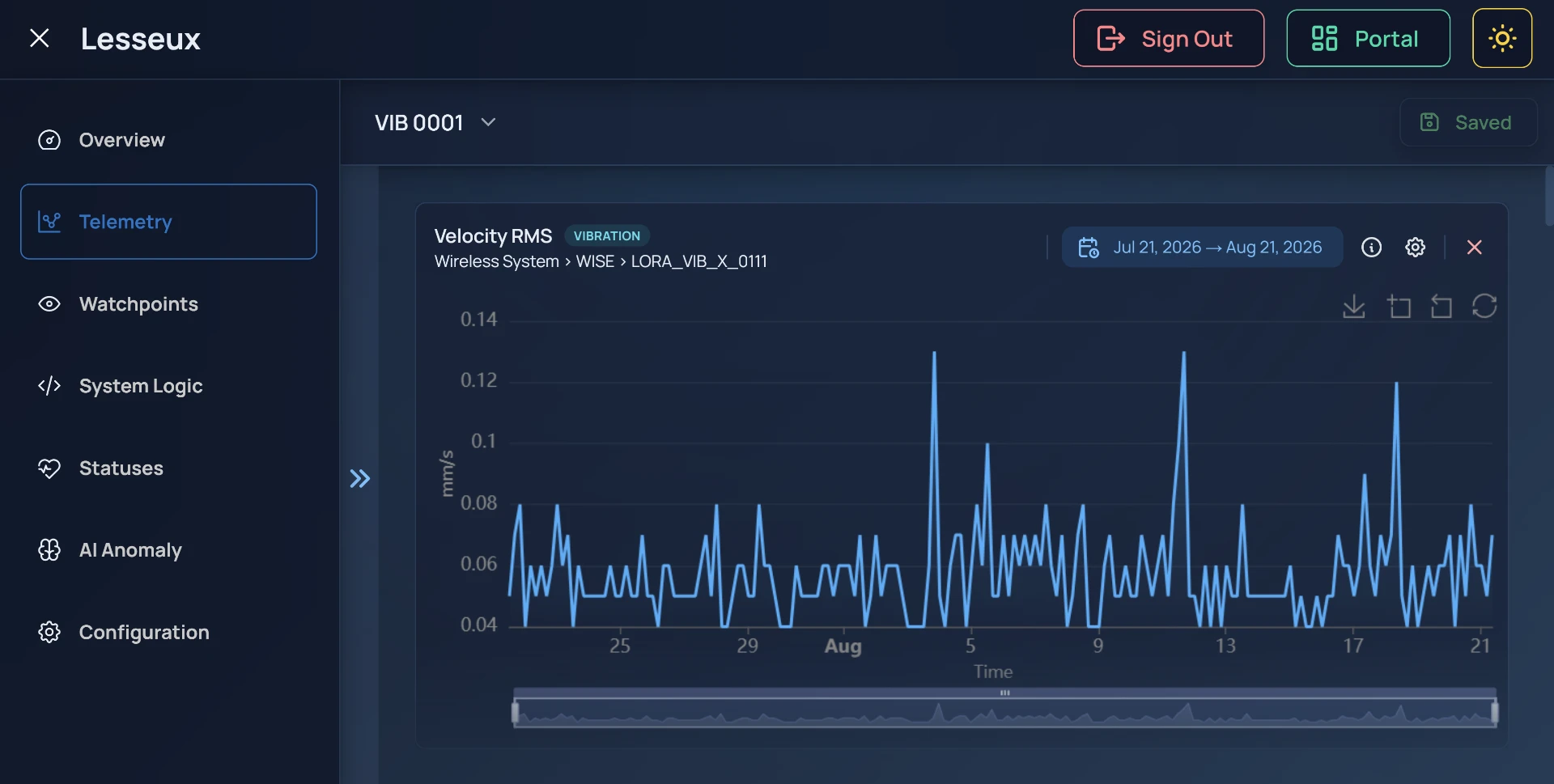
Wireless VibraSens sensors do capture raw waveforms and run deep DSP — FFT, envelope and spectrogram — but on a duty-cycled interval with fewer data points per capture than the wired path. For continuous raw streaming and sub-second physical I/O reaction, use the wired EtherCAT variant.
No. The edge system is a one-off hardware and licence purchase that you own outright and that keeps running with no connection to us. The optional cloud fleet dashboard is the only item that recurs, and only if you opt in.
24-bit resolution lets SensorDataFabrics resolve bearing defect energy down to roughly 12 RPM, where 16-bit systems only see their own noise floor.
EtherCAT millisecond control where you need wires. LoRaWAN miles of range where you don't.